
Air Changes Per Hour (ACH) Verification — The Cleanroom Measurement Most Facilities Underestimate
Published by LabCertTech LLC | Houston, Texas
When compounding pharmacy directors think about cleanroom certification, particle counts and HEPA filter integrity testing typically come to mind first. Air Changes Per Hour (ACPH) verification is less discussed — but it is equally critical to your USP 797 and USP 800 compliance status and your facility’s ability to maintain required ISO classifications under real operating conditions.
Understanding what ACPH is, what USP 797 and USP 800 actually require for each area of your facility, and why the distinction between HVAC-contributed and PEC-contributed ACPH matters could make a significant difference in how your facility approaches its compliance program.
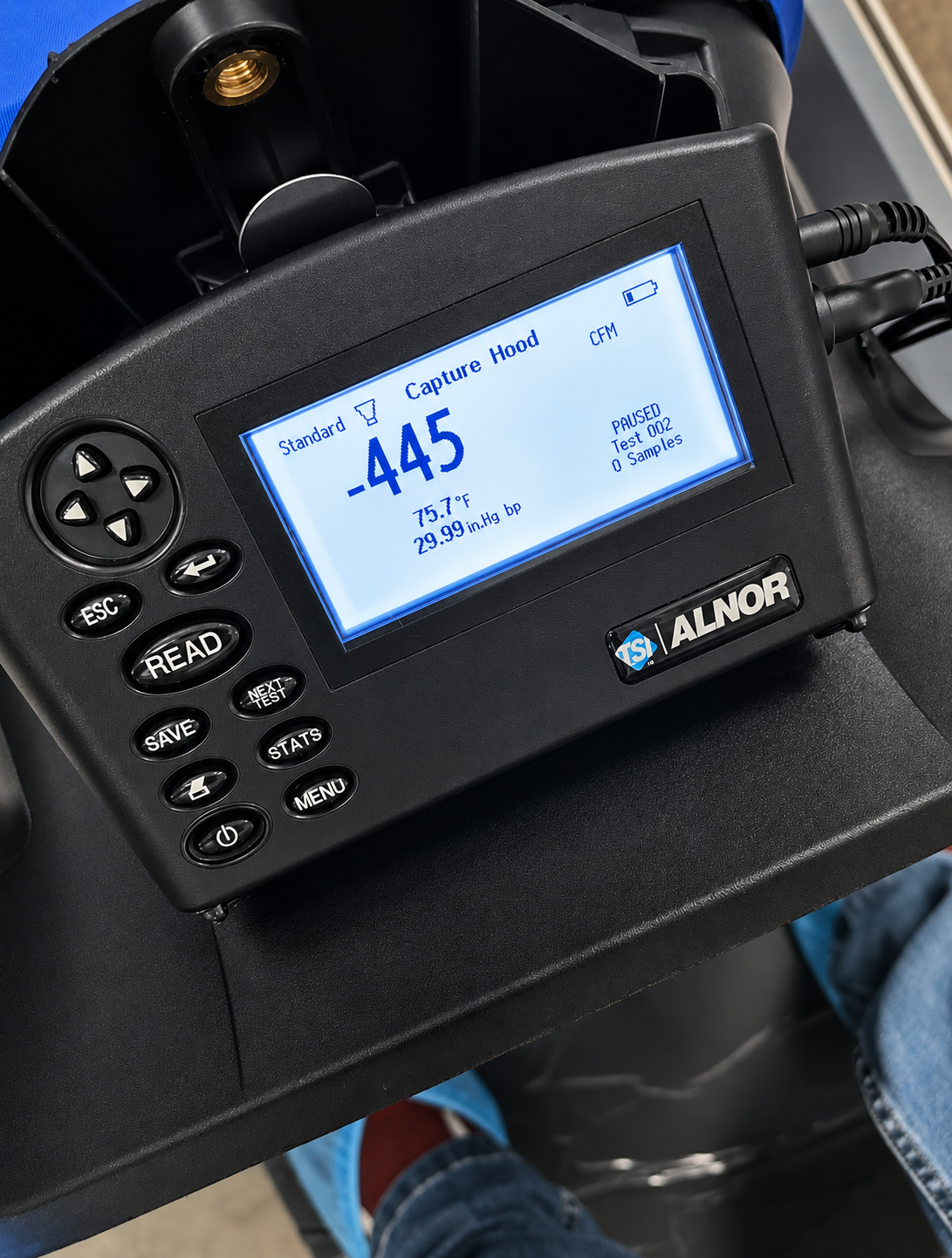
LabCertTech performing Air Changes Per Hour (ACPH) verification during cleanroom certification — Houston, Texas
What is Air Changes Per Hour?
Air Changes Per Hour (ACPH) is a measurement of how many times the total volume of air in a cleanroom or controlled environment is replaced with HEPA filtered supply air within one hour. It is calculated by dividing the total volume of supply air delivered to the room per hour by the total volume of the room.
ACPH is the primary mechanism by which your HVAC system dilutes and removes the airborne particles, microorganisms, and contaminants generated by compounding personnel, equipment operation, and normal activity inside the cleanroom. The higher the ACPH — within design limits — the more rapidly the cleanroom environment recovers from particle-generating events and maintains its required ISO classification.
What USP 797 and USP 800 Actually Require for ACPH
One of the most important things to understand about ACPH requirements is that they differ significantly depending on which standard applies and which area of your facility is being evaluated. The 12 ACPH and 30 ACPH requirements are not interchangeable — each applies to a specific area and context defined by USP 797 or USP 800.
| Area / Configuration | Standard | Minimum ACPH | Additional Requirements |
|---|---|---|---|
| ISO 7 buffer room — sterile compounding | USP 797 | 30 ACPH | HEPA filtered supply air |
| ISO 7 buffer room — sterile HD compounding (C-SEC) | USP 800 | 30 ACPH | Externally vented, negative pressure 0.01-0.03″ w.c. |
| Nonsterile HD compounding C-SEC | USP 800 | 12 ACPH | Externally vented, negative pressure 0.01-0.03″ w.c. |
| Containment Segregated Compounding Area (C-SCA) | USP 800 | 12 ACPH | Externally vented, negative pressure 0.01-0.03″ w.c. |
| HD storage — antineoplastic and HD APIs | USP 800 | 12 ACPH | Externally vented, negative pressure room |
| Refrigerated antineoplastic HD storage | USP 800 | 12 ACPH | Dedicated refrigerator in negative pressure area |
💡 Key distinction: The 12 ACPH requirement in USP 800 applies specifically to storage areas, nonsterile HD compounding C-SECs, and C-SCAs — not to ISO 7 buffer rooms used for sterile HD compounding. ISO 7 buffer rooms used for sterile HD compounding under USP 800 require 30 ACPH — the same as USP 797 sterile compounding buffer rooms. This is one of the most commonly misunderstood ACPH requirements in the industry.
USP 800 Storage Requirements — 12 ACPH
USP 800 Section 5.2 requires that antineoplastic HDs and all HD APIs that require manipulation must be stored in an externally ventilated, negative pressure room with at least 12 ACPH. This applies to:
- Storage rooms for antineoplastic hazardous drugs requiring manipulation
- Storage rooms for any hazardous drug active pharmaceutical ingredients (APIs)
- Areas where refrigerated antineoplastic HDs are stored — dedicated refrigerators in negative pressure areas with at least 12 ACPH
The 12 ACPH requirement for storage reflects the need to control vapor and aerosol contamination in areas where HDs are stored — but does not rise to the higher standard required for active compounding environments.
USP 800 Nonsterile HD Compounding — 12 ACPH C-SEC
For nonsterile HD compounding, USP 800 requires that the C-PEC be placed in a Containment Secondary Engineering Control (C-SEC) that has at least 12 ACPH, is externally vented, and maintains negative pressure between 0.01 and 0.03 inches of water column relative to adjacent areas.
USP 800 Table 2 summarizes the engineering controls for nonsterile HD compounding:
- C-PEC — externally vented (preferred) or redundant HEPA filtered in series; examples include CVE, Class I or II BSC, CACI
- C-SEC requirements — externally vented, minimum 12 ACPH, negative pressure 0.01-0.03″ w.c. relative to adjacent areas
USP 800 Sterile HD Compounding — 30 ACPH C-SEC
For sterile HD compounding, the requirements are significantly more stringent. When the C-PEC is placed in an ISO Class 7 buffer room with an ISO Class 7 ante-room, USP 800 requires:
- 30 ACPH of HEPA filtered supply air
- Externally vented
- Negative pressure between 0.01 and 0.03 inches of water column relative to adjacent areas
- The ante-room must maintain positive pressure of at least 0.02 inches of water column relative to all adjacent unclassified areas and maintain ISO Class 7 air quality
⚠️ Common compliance misconception: Some facilities assume that because USP 800 references 12 ACPH, their sterile HD compounding ISO 7 buffer room only needs 12 ACPH. This is incorrect. The 12 ACPH requirement in USP 800 applies to storage areas, nonsterile compounding C-SECs, and C-SCAs — not to ISO 7 buffer rooms used for sterile hazardous drug compounding, which require 30 ACPH.
The Three ACPH Values USP 797 Requires You to Document
USP 797 Section 5 requires that three distinct ACPH values be measured and documented in every certification report — not just a single total value:
- ACPH contributed by the HVAC system — the baseline air exchange rate from your facility’s supply system, independent of the PEC
- ACPH contributed by the PEC — the air exchange contribution from the BSC, LAFW, CAI, or CACI
- Total ACPH combining both sources — the value evaluated against the minimum ACPH requirement
This three-value documentation requirement matters for a critical practical reason: a buffer room that meets the 30 ACPH minimum only when the PEC contribution is included may fall below the required threshold when the PEC is taken offline for maintenance or HEPA filter replacement. Knowing the HVAC-only ACPH tells you whether your room is compliant with the PEC offline.
📋 Documentation requirement: A certification report that documents only a single total ACPH value — without separately documenting the HVAC contribution and PEC contribution — does not fully satisfy USP 797 Section 5 documentation requirements. All three values must be present in every compliant certification report.
How ACPH is Measured During Certification
ACPH verification requires accurate measurement of the supply air volume being delivered to the cleanroom. Our certification team performs ACPH testing using calibrated airflow measurement equipment including:
- Calibrated flow hood — placed over each supply diffuser to measure the volume of air being delivered
- Room volume calculation — based on actual measured room dimensions
- HVAC ACPH calculation — total supply air volume per hour divided by room volume
- PEC contribution calculation — based on PEC operating parameters and published specifications
- Total ACPH determination — compared against applicable USP 797 or USP 800 minimum requirements
What Happens When ACPH Falls Below Required Minimums
When ACPH measurements fall below required minimums the certification professional must document the deficiency and the facility must take corrective action before returning the affected areas to compounding service. Common causes include:
- HVAC system imbalance or blower degradation reducing supply air volume
- Clogged or restricted supply air filters
- Blocked or partially closed supply diffusers
- Ductwork restrictions or leaks
- HVAC system not sized adequately for the room volume
- Seasonal HVAC performance variations
LabCertTech documents all ACPH measurements and provides the specific data your HVAC contractor needs to identify and correct the root cause of any ACPH deficiency.
How LabCertTech Performs ACPH Verification
LabCertTech LLC performs comprehensive ACPH verification as part of every cleanroom certification for compounding pharmacies, hospitals, and healthcare facilities across Houston, Texas and surrounding areas. We measure and document all three USP 797 Section 5 required ACPH values and verify compliance against the correct ACPH minimum for each specific area — whether that is 30 ACPH for ISO 7 buffer rooms under USP 797 and USP 800 sterile HD compounding, or 12 ACPH for USP 800 storage areas, nonsterile HD compounding C-SECs, and C-SCAs.
Ready to Schedule Your Cleanroom Certification?
Contact LabCertTech today — Houston’s veteran owned, NSF 49 certified laboratory certification company.
Schedule a CertificationAir Changes Per Hour ACPH Verification USP 797 USP 800 Cleanroom Certification Houston TX LabCertTech