
USP 797 Section 5 — Certification and Recertification Requirements Every Compounding Pharmacy Must Meet
Published by LabCertTech LLC | Houston, Texas
Before a compounding area is used to compound any Category 1, Category 2, or Category 3 CSPs, USP 797 Section 5 requires that it be independently certified. This certification must confirm that the compounding area is meeting its design and air quality specifications. Understanding exactly what USP 797 Section 5 requires — what tests must be performed, when recertification is triggered, and what documentation must be maintained — is essential for every compounding pharmacy director and quality manager.
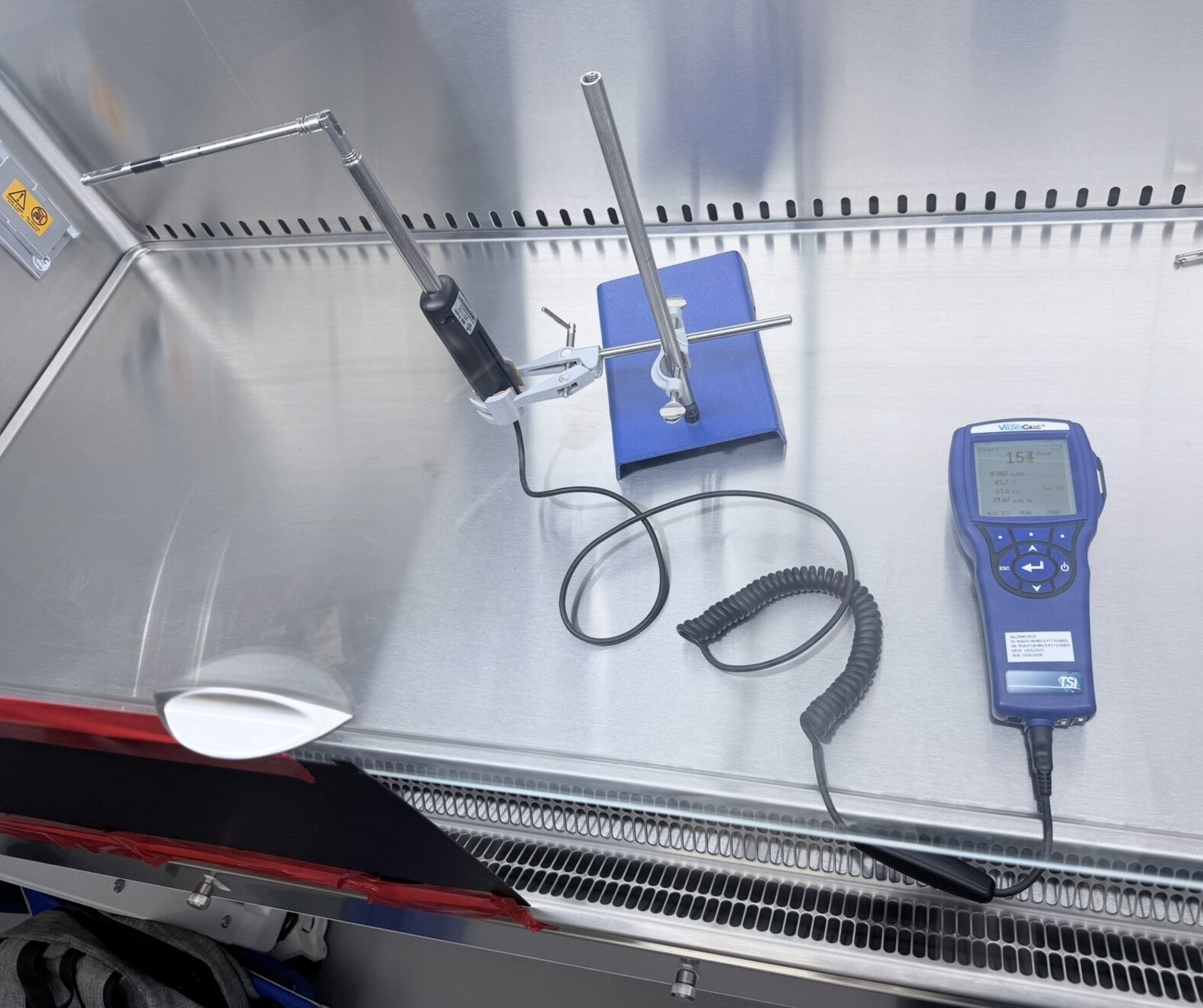
LabCertTech NSF 49 certified technician performing certification in Houston, Texas
The Fundamental Requirement — Independent Certification
USP 797 Section 5 establishes that certification must be performed independently — meaning by a qualified certification professional who is not a facility employee performing self-certification. This independent certification must confirm two things:
- The compounding area is meeting its design specifications — the physical and mechanical performance the space was designed to achieve
- The compounding area is meeting its air quality specifications — the ISO classification requirements defined in USP 797 for each classified area
This requirement applies to all classified areas including the Primary Engineering Control (PEC), the ISO 7 buffer room, and the ISO 8 ante-room. No classified area may be used for compounding until it has been independently certified.
Certification Frequency — Every 6 Months Minimum
USP 797 Section 5 requires that certification of classified areas including the PEC be performed initially and recertification must be performed at least every 6 months. This 6-month interval is a minimum requirement — your facility’s quality program, state board of pharmacy requirements, or accreditation standards may require more frequent certification.
📋 Critical compliance point: The 6-month certification requirement applies to all classified areas and all PECs — not just the cleanroom as a whole. Each BSC, LAFW, CAI, and CACI must be individually certified every 6 months in addition to the room certification. A facility with multiple PECs must ensure each one has a current, valid certification.
The 4 Required Tests Under USP 797 Section 5
USP 797 Section 5 specifies four distinct tests that must be included in every certification. Each test serves a specific and critical purpose in verifying the performance of your compounding environment:
1. Airflow Testing
Airflow testing is performed to determine the acceptability of air velocity, the room air exchange rate, and the room pressure differential in doorways between adjacent rooms. The purpose is to ensure consistent airflow and verify that the appropriate quality of air is maintained under dynamic operating conditions. USP 797 Section 5 specifically requires that three airflow measurements be documented in the certification report:
- The ACPH contributed from the HVAC system
- The ACPH contributed from the PEC
- The total ACPH combining both sources
2. HEPA Filter Integrity Testing
HEPA filters must be leak tested at the factory and then leak tested again after installation and as part of recertification. This requirement reflects the fact that HEPA filters can develop leaks during shipping, installation, or normal operation that are invisible to the naked eye but can significantly compromise air quality. HEPA filter integrity testing uses aerosol challenge testing — typically PAO or DOP aerosol — to detect any leaks in the filter media, filter frame, or filter housing seals.
3. Total Particle Count Testing
Total particle count testing must be performed under dynamic operating conditions using calibrated electronic equipment. This test verifies that each classified area meets its required ISO classification — ISO 5 for PEC work zones, ISO 7 for buffer rooms, and ISO 8 for ante-rooms. USP 797 Section 5 references Section 5.1 Total Airborne Particle Sampling for the detailed requirements governing how, where, and under what conditions particle count testing must be performed.
4. Dynamic Airflow Smoke Pattern Test
Smoke pattern tests must be performed for each PEC during dynamic operating conditions to demonstrate unidirectional airflow and sweeping action over and away from the preparations. This test uses smoke visualization to verify that the airflow pattern inside the PEC is functioning correctly — that clean air flows in a smooth, unidirectional pattern across the critical work zone, sweeping particles and contaminants away from sterile preparations. A PEC that produces turbulent or non-unidirectional airflow during smoke pattern testing cannot be considered compliant regardless of its particle count results.
⚠️ All four tests are required: USP 797 Section 5 does not permit selective certification — all four tests must be performed and documented at every certification visit. A certification report that omits any of the four required tests does not satisfy USP 797 Section 5 requirements, regardless of how well the facility performs on the tests that were completed.
When Recertification is Triggered Outside the 6-Month Schedule
Beyond the routine 6-month certification schedule, USP 797 Section 5 requires that classified areas be recertified if there are changes to the area such as:
- Redesign or construction — any physical modification to the cleanroom space
- Replacement or relocation of any PEC — moving a BSC to a new location or replacing it with a new unit
- Alteration in the configuration of the room — any change that could affect airflow or air quality
These triggering events require recertification before the affected areas are returned to service — regardless of when the last routine certification was performed. A facility that moves a BSC to a new location and resumes compounding without recertification is operating out of compliance with USP 797 Section 5 even if the BSC was certified just weeks earlier.
Personnel Documentation Requirements During Certification
USP 797 Section 5 includes an important personnel documentation requirement that is frequently overlooked: the number of personnel present in each PEC and SEC during total particle count tests and dynamic airflow smoke pattern tests must be documented.
This requirement reflects the fact that personnel generate particles — and the number of personnel present during testing directly affects the particle count results obtained. Documenting personnel count provides context for understanding certification results and allows meaningful comparison between certification visits.
Certification and Recertification Records
USP 797 Section 5 requires that all certification and recertification records be reviewed by the designated person(s) to ensure that the classified environments meet the minimum requirements of the chapter. This means:
- Certification reports must be reviewed — not simply filed away
- The designated person must confirm that all required tests were performed
- The designated person must confirm that all results meet USP 797 minimum requirements
- Records must be maintained in accordance with USP 797 Section 20 Documentation requirements
📋 Corrective action requirement: A corrective action plan must be implemented and documented in response to any out-of-range results. Data collected in response to corrective actions must be reviewed to confirm that the actions taken have been effective. This applies to any test result that falls outside the required limits — not just particle count results.
What a Complete USP 797 Section 5 Certification Report Must Include
Based on USP 797 Section 5 requirements, a complete certification report must document:
- All four required tests — airflow testing, HEPA filter integrity, total particle count, and dynamic airflow smoke pattern
- ACPH from HVAC, ACPH from PEC, and total ACPH
- Room pressure differentials between all adjacent classified spaces
- Particle count results at all required sampling locations under dynamic conditions
- HEPA filter integrity test results for all supply and exhaust filters
- Dynamic airflow smoke pattern test results for each PEC
- Number of personnel present during particle count and smoke pattern tests
- Pass/fail determination for each test relative to USP 797 requirements
- Any out-of-range results and associated corrective action documentation
- Certifier credentials and signature
- Certification date and next certification due date
How LabCertTech Fulfills USP 797 Section 5 Requirements
LabCertTech LLC performs all four required USP 797 Section 5 certification tests for compounding pharmacies, hospitals, and healthcare facilities across Houston, Texas and surrounding areas. Our NSF 49 certified technicians perform airflow testing, HEPA filter integrity testing, total particle count testing under dynamic conditions, and dynamic airflow smoke pattern testing for every PEC at every certification visit.
Our certification reports are designed to document all USP 797 Section 5 required data — including ACPH measurements, pressure differentials, particle counts, filter integrity results, smoke pattern test documentation, and personnel counts — providing the complete certification record your designated person needs to review and your state board inspector expects to see.
Ready to Schedule Your USP 797 Section 5 Certification?
Contact LabCertTech today — Houston’s veteran owned, NSF 49 certified laboratory certification company.
Schedule a CertificationUSP 797 Cleanroom Certification Recertification HEPA Filter Testing Particle Count Testing Houston TX LabCertTech