
USP 797 Table 7 — Viable Air Sampling Action Levels Explained for Compounding Pharmacies
Published by LabCertTech LLC | Houston, Texas
For compounding pharmacies operating under USP 797, viable air sampling is a non-negotiable component of your environmental monitoring program. But collecting viable air samples is only half the requirement — knowing exactly what to do when your results exceed the action levels defined in USP 797 Table 7 is equally critical. This post breaks down Table 7, explains what each action level means in practice, and walks through the step-by-step response USP 797 Section 6.2.3 requires when those levels are exceeded.
LabCertTech LLC — Cleanroom Certification and Environmental Monitoring Services, Houston, Texas
What is Viable Air Sampling?
Viable air sampling is the collection and culture of airborne microorganisms in your compounding environment using a calibrated impaction air sampler and appropriate growth media. Unlike total airborne particle count testing — which measures all particles regardless of whether they are microbial — viable air sampling specifically targets living microorganisms that could contaminate your sterile preparations and harm patients.
Viable air sampling results are expressed in Colony Forming Units per cubic meter (CFU/m³) — the number of viable microorganism colonies that grow from a defined volume of sampled air. The lower the CFU count, the cleaner your air environment.
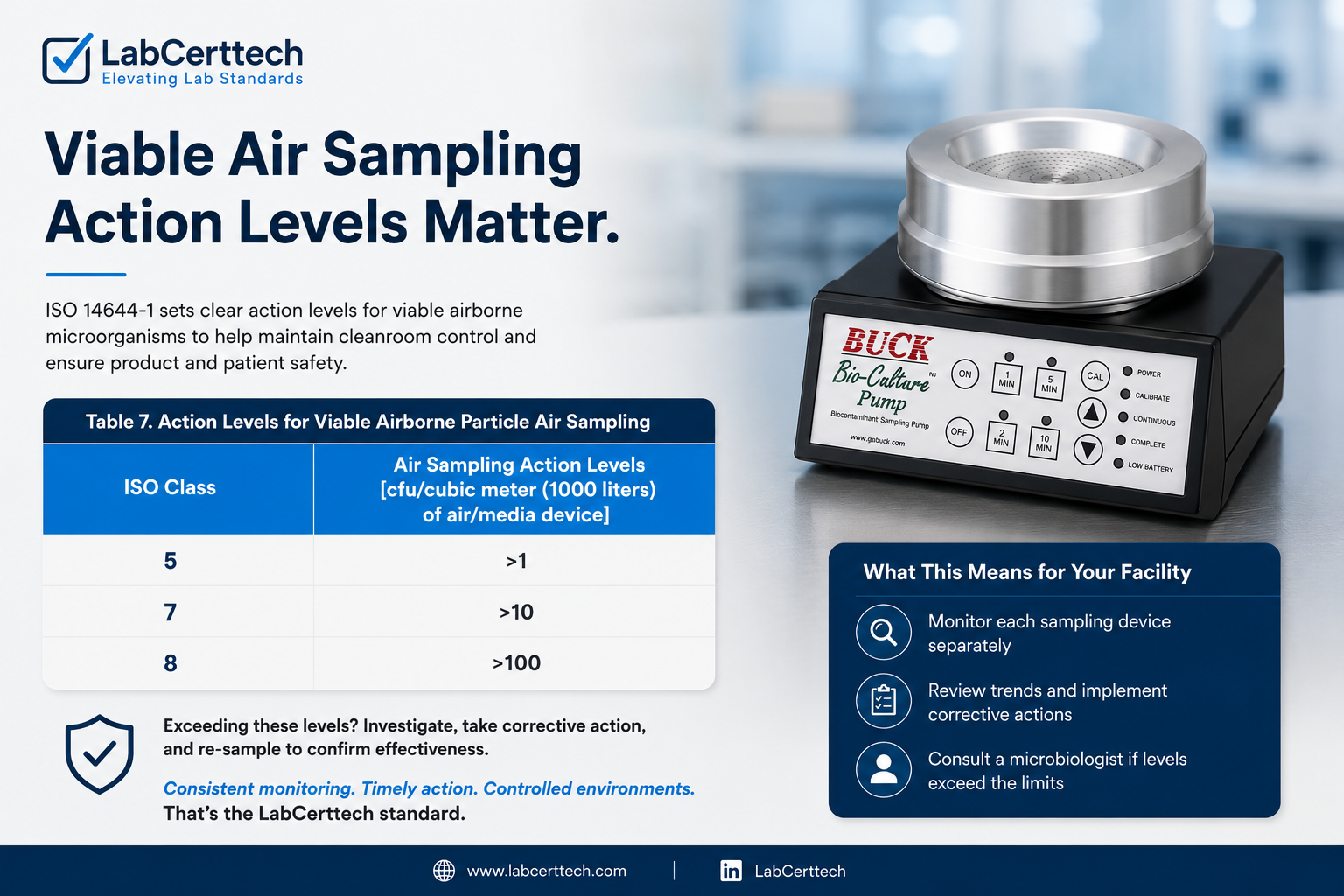
USP 797 Table 7 — Action Levels for Viable Airborne Particle Air Sampling
USP 797 Table 7 defines the action levels for viable air sampling results by ISO classification. When CFU counts exceed these levels, immediate investigation and corrective action are required:
| ISO Class | Air Sampling Action Level (CFU/m³ of air/media device) | Area in Compounding Suite |
|---|---|---|
| ISO Class 5 | Greater than 1 CFU/m³ | PEC work zone (BSC, LAFW, CAI, CACI) |
| ISO Class 7 | Greater than 10 CFU/m³ | Buffer room |
| ISO Class 8 | Greater than 100 CFU/m³ | Ante-room |
🦠 Critical point about ISO 5: The action level for your ISO 5 PEC work zone is greater than 1 CFU/m³ — meaning a single colony forming unit detected in your ISO 5 zone triggers the full action level response protocol. This reflects the absolute sterility requirement of the critical work zone where your sterile preparations are compounded.
Understanding the Two-Device Rule
USP 797 Section 6.2.3 includes an important clarification about multi-device sampling: if two sampling media devices are collected at a single location, all growth on each must be documented and action levels applied to each sampling media device separately.
This means you cannot average the results of two devices collected at the same location. If either device exceeds the action level, the full corrective action protocol must be initiated — regardless of what the other device shows.
What USP 797 Section 6.2.3 Requires When Action Levels Are Exceeded
When viable air sampling results exceed the Table 7 action levels, USP 797 Section 6.2.3 establishes a specific, documented response protocol. Here is exactly what is required:
Investigate the Cause
The cause of the exceedance must be investigated. The extent of the investigation should be consistent with the deviation and should include an evaluation of trends. A single isolated result may warrant a different level of investigation than a pattern of recurring exceedances at the same location.
Take Corrective Action
Appropriate corrective action must be taken to address the root cause. USP 797 Section 6.2.3 provides specific examples of corrective actions including process or facility improvements, personnel training, cleaning and disinfecting, or HEPA filter repair and/or replacement. The corrective action must be proportionate to the severity and pattern of the exceedance.
Document the Corrective Action Plan
The corrective action plan must be documented. A verbal decision to “clean more thoroughly” is not sufficient. The specific corrective actions taken, the personnel responsible, and the timeline for implementation must all be written down and retained as part of your quality records.
Resample Failed Areas
The corrective action plan must include resampling of failed areas to confirm corrective action was successful. You cannot simply assume that your corrective actions worked — you must obtain passing viable air sampling results from the affected areas before considering the exceedance resolved.
Review Data to Confirm Effectiveness
Data collected in response to corrective actions must be reviewed to confirm that the actions taken have been effective. This means comparing the resampling results against the Table 7 action levels and documenting that passing results were achieved.
Attempt Microorganism Identification
When viable air sampling results exceed Table 7 action levels, USP 797 Section 6.2.3 requires that an attempt be made to identify any microorganisms recovered to the genus level with the assistance of a microbiologist. This identification can provide critical information about the likely source of contamination and help guide more targeted corrective actions.
Evaluate Trends
CFU counts must be examined in relation to previous data to identify adverse results or trends. A single exceedance may be an isolated event — but a pattern of elevated results at the same location over multiple sampling events indicates a systemic problem that requires a more comprehensive investigation and corrective action response.
⚠️ Common inspection finding: Many facilities perform viable air sampling and obtain results — but when action levels are exceeded, the response is inadequate. Simply re-cleaning and re-sampling without documenting the investigation, corrective action plan, and trend evaluation does not satisfy USP 797 Section 6.2.3 requirements. Inspectors will ask to see the complete corrective action documentation for every exceedance in your records.
Trending — The Overlooked Requirement
One of the most frequently cited deficiencies in environmental monitoring programs is inadequate trending. USP 797 Section 6.2.3 requires that CFU counts be examined in relation to previous data to identify adverse results or trends.
Effective trending means:
- Maintaining a log of all viable air sampling results by location and date
- Graphing results over time to visually identify upward trends
- Establishing alert levels below the Table 7 action levels to trigger early investigation
- Reviewing trending data at defined intervals as part of your quality review process
- Correlating viable air sampling trends with other quality indicators including surface sampling, cleaning records, and personnel changes
A facility that identifies and responds to upward trends before action levels are exceeded demonstrates a proactive quality culture that inspectors recognize and respect. A facility that only reacts after action levels are exceeded — with no trend data to show — is in a much more difficult compliance position.
Documentation is Everything
Every element of your viable air sampling program must be thoroughly documented:
- Date, time, and location of every sample collected
- Sampling method and equipment used
- CFU counts for every sample with organism identification when applicable
- Pass/fail status relative to Table 7 action levels
- Complete corrective action documentation for every exceedance
- Resampling results confirming corrective action effectiveness
- Trending data and periodic trend review records
These records must be retained for the period required by your state board of pharmacy — typically a minimum of 3 years — and must be available for review during inspections.
How LabCertTech Can Help
LabCertTech LLC provides comprehensive viable air sampling and environmental monitoring services for compounding pharmacies and healthcare facilities across Houston, Texas and surrounding areas. Our team performs viable air sampling at all required locations using calibrated impaction air samplers and provides detailed reports documenting CFU counts, pass/fail status relative to Table 7 action levels, and sampling conditions.
We also provide proactive guidance when action levels are exceeded — helping your team understand what USP 797 Section 6.2.3 requires and supporting your corrective action documentation process.
Ready to Strengthen Your Viable Air Sampling Program?
Contact LabCertTech today — Houston’s veteran owned laboratory certification company.
Schedule a ConsultationUSP 797 Viable Air Sampling Action Levels Environmental Monitoring Compounding Pharmacy Houston TX LabCertTech