
USP 797 Section 5.1 — Total Airborne Particle Sampling Requirements Explained
Published by LabCertTech LLC | Houston, Texas
Of all the testing requirements under USP 797, total airborne particle count sampling is one of the most fundamental — and one of the most directly connected to your facility’s ISO classification status and Beyond Use Date authority. Section 5.1 of USP 797 establishes clear requirements for how, where, when, and under what conditions total airborne particle sampling must be conducted. Understanding these requirements is essential for every compounding pharmacy director and compliance officer.
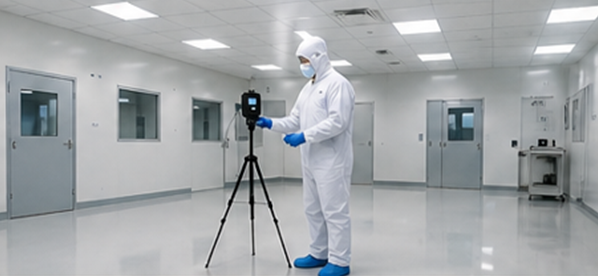
Total airborne particle count testing during cleanroom certification — Houston, Texas
What is Total Airborne Particle Sampling?
Total airborne particle sampling — also called particle count testing — is the process of measuring the concentration of airborne particles of specific sizes in your cleanroom environment using a calibrated optical particle counter. The results of particle count testing determine whether your compounding environment meets the ISO classification requirements specified in USP 797.
Under USP 797, total airborne particle sampling serves two distinct but equally important purposes:
- Certification testing — performed by a qualified certification professional every 6 months to verify that your engineering controls and cleanroom environment meet required ISO classifications
- Ongoing monitoring — performed as part of your environmental monitoring program to verify that ISO classifications are being maintained between certification visits
📋 USP 797 Section 5.1 key requirement: Total airborne particle count testing must be conducted in all classified areas during dynamic operating conditions at least every 6 months to measure the performance of the engineering controls being used to provide the specified levels of air cleanliness.
Dynamic Operating Conditions — What Does This Mean?
One of the most important — and most frequently misunderstood — requirements in USP 797 Section 5.1 is that particle count testing must be performed under dynamic operating conditions. This means testing must be performed while the cleanroom is in normal operation — not in an empty, static state.
Dynamic operating conditions means:
- Personnel are present and performing normal compounding activities or simulating them
- Equipment is operating as it would during normal compounding
- The environment represents the actual conditions under which CSPs are compounded
- All HVAC systems are operating at normal settings
Testing under dynamic conditions is more challenging and typically produces higher particle counts than testing in an empty room — but it provides a much more meaningful and accurate picture of your actual compounding environment. Particle count results obtained under static conditions do not accurately represent the ISO classification of your facility during actual compounding operations.
⚠️ Common compliance issue: Facilities that test under static conditions — empty room, no personnel, no activity — may achieve passing particle counts that do not reflect actual operating conditions. State board of pharmacy inspectors are increasingly asking about testing conditions, and certification reports that do not document dynamic testing conditions may face scrutiny.
Where Must Particle Sampling Be Conducted?
USP 797 Section 5.1 requires that total airborne particle sampling sites be selected in all classified areas. Specifically:
- Primary Engineering Controls (PECs) — sampling must be taken at locations where there is greatest risk to exposed CSPs, containers, and closures inside the PEC
- ISO 7 buffer room — sampling must be taken at multiple representative locations throughout the buffer room
- ISO 8 ante-room — sampling must be taken at multiple representative locations throughout the ante-room
USP 797 also requires that all sampling sites and procedures be described in the facility’s Standard Operating Procedures (SOPs). This means your facility must have documented, written procedures that specify exactly where samples are taken during each certification visit — and those locations must be consistent between visits to allow meaningful trending.
ISO Classification Requirements Under USP 797
Total airborne particle sampling verifies that your compounding environment meets the following ISO classification requirements:
| Area | Required ISO Classification | Maximum Particles ≥0.5µm /m³ | Testing Frequency |
|---|---|---|---|
| PEC work zone (ISO 5) | ISO Class 5 | 3,520 | Every 6 months |
| Buffer room (ISO 7) | ISO Class 7 | 352,000 | Every 6 months |
| Ante-room (ISO 8) | ISO Class 8 | 3,520,000 | Every 6 months |
💡 Why ISO 5 matters most: The ISO 5 classification of your PEC is the most critical measurement in the entire certification process. It is the direct documentary basis for your Category 2 BUD authority. If your PEC fails ISO 5 — even with a single particle count measurement above the limit — your Category 2 BUD authority is compromised until the PEC is repaired and recertified.
Action Levels and Corrective Action Requirements
USP 797 Section 5.1 establishes clear requirements for what must happen when particle count results exceed ISO classification limits:
- Investigation required — the cause of the exceedance must be investigated and documented
- Corrective action required — appropriate corrective action must be taken to address the root cause
- Verification required — data collected in response to corrective actions must be reviewed to confirm the actions taken have been effective
- Trend evaluation required — the extent of investigation should be consistent with the deviation and should include an evaluation of trends
Examples of corrective actions cited in USP 797 Section 5.1 include process or facility improvements, or HEPA filter replacement or repair. Simply re-testing and obtaining a passing result without investigating and documenting the root cause is not sufficient to meet USP 797 corrective action requirements.
⚠️ Documentation requirement: Every particle count exceedance — and every corrective action taken in response — must be fully documented and retained. Inspectors will ask to see your exceedance history and corrective action records. An undocumented corrective action is, from a compliance standpoint, the same as no corrective action at all.
Care During PEC Sampling — Avoiding Airflow Disturbance
USP 797 Section 5.1 includes a specific requirement that is critically important for certification professionals: when conducting particle sampling of the PEC, care should be taken to avoid disturbing the unidirectional airflow within the PEC.
This requirement reflects the fact that particle counters and their sample tubes can disrupt the carefully balanced laminar airflow inside a BSC, LAFW, or isolator if not positioned and handled correctly. Improper sampling technique can both artificially inflate particle counts and compromise the sterility assurance of any preparations being compounded.
This is one of the many reasons why particle count testing should be performed by a qualified certification professional with specific training and experience in cleanroom and PEC certification — not by facility staff using borrowed equipment.
The Connection Between Particle Sampling and Your Certification Report
Every particle count measurement taken during your certification visit must be documented in your certification report with:
- Sample location and description
- Number of sample runs taken at each location
- Particle counts at each measurement point for both 0.5µm and 5.0µm particle sizes
- Calculated ISO classification based on measured counts
- Pass/fail determination relative to required ISO classification
- Testing conditions including whether testing was performed under dynamic or static conditions
This documentation is what connects your certification results to your BUD assignment authority — and what inspectors will examine when they review your certification records.
How LabCertTech Performs Total Airborne Particle Sampling
LabCertTech LLC performs total airborne particle count testing using calibrated optical particle counters in accordance with USP 797 Section 5.1 and ISO 14644 requirements. We perform testing under dynamic operating conditions at all required sampling locations — including PEC work zones, buffer rooms, and ante-rooms — and document all results in detailed certification reports that meet USP 797 documentation requirements.
Our certification reports clearly document sampling locations, measured particle counts, ISO classification determinations, and testing conditions — providing the complete documentary record your facility needs to support Category 2 BUD assignments and withstand state board of pharmacy inspection scrutiny.
Ready to Schedule Your Cleanroom Certification?
Contact LabCertTech today — Houston’s veteran owned laboratory certification company.
Schedule a CertificationUSP 797 Airborne Particle Sampling Particle Count Testing ISO 14644 Cleanroom Certification Houston TX LabCertTech