
Standards Explained
What Is NSF/ANSI 49?
The Standard Behind Every BSC Certification
If you operate a biological safety cabinet, NSF/ANSI 49 is the standard that defines whether it’s actually safe — and whether your certification means anything.
By LabCertTech LLC | Houston, TX | Cleanroom & Equipment Certification Specialists
When a certifier places a certification sticker on your biological safety cabinet, that sticker isn’t just a date. It’s a claim that the cabinet was tested and performed within the requirements of a specific standard. That standard, in virtually every case, is NSF/ANSI 49.
Yet most pharmacy directors, lab managers, and facility operators have never read NSF/ANSI 49 and aren’t entirely sure what it governs. That’s not a criticism — it’s a gap that matters when you’re responsible for a USP <797> audit, a Joint Commission survey, or the safety of the people working at those cabinets every day.
This post explains what NSF/ANSI 49 actually is, what it requires, why it exists, and how LabCertTech uses it to certify biological safety cabinets across pharmacies, hospitals, and research facilities in the Houston area.
In This Guide
1. What Is NSF/ANSI 49?
NSF/ANSI 49 — formally titled Biosafety Cabinetry: Design, Construction, Performance, and Field Certification — is the primary American National Standard governing biological safety cabinets. It is published and maintained by NSF International, an independent public health and safety organization, in coordination with the American National Standards Institute (ANSI).
The standard establishes:
- How biological safety cabinets must be designed and constructed to achieve containment
- What performance criteria a cabinet must meet — including inflow velocity, downflow velocity, HEPA filtration efficiency, and containment
- The test methods and protocols used to verify that performance both at the factory and in the field
- The qualifications and responsibilities of certifiers who perform field testing
- Requirements for labeling and documentation of certified cabinets
In short: NSF/ANSI 49 defines what a biological safety cabinet is supposed to do, how to prove it’s doing it, and who is qualified to make that determination.
💡 Quick Distinction
NSF/ANSI 49 is the standard. NSF International is the organization that publishes it. A cabinet marked “NSF 49 Listed” has been factory-tested and approved by NSF International. A cabinet with an “NSF/ANSI 49 Field Certification” sticker has been tested in your facility by a qualified certifier — using the protocols defined in the standard. Both matter, but for your annual compliance obligation, it’s the field certification that counts.
2. Why NSF/ANSI 49 Exists
Biological safety cabinets were developed in the mid-20th century as microbiological research expanded and the risk of laboratory-acquired infections became better understood. Early BSCs had no standardized performance requirements — a cabinet from one manufacturer might perform very differently from one made by another, and there was no agreed-upon way to verify containment in the field.
NSF/ANSI 49 emerged from that gap. The first version was published in 1976, and it has been revised multiple times since — most recently reflecting advances in cabinet design, HEPA filtration, and field testing methodology. The current version provides a consistent, nationally recognized framework that:
- Ensures all certified BSCs meet a minimum performance threshold regardless of manufacturer
- Gives regulatory bodies (FDA, state boards of pharmacy, accreditation organizations) a specific standard to reference in their requirements
- Provides facility operators with a documented, defensible record that their cabinets are functioning as designed
- Establishes accountability — certifiers are identified by name on the certification report and are responsible for the accuracy of their findings
Without NSF/ANSI 49, there would be no shared language for what “certified” means when it comes to a BSC. Every facility, every certifier, and every regulator would be working from a different baseline — which is exactly the kind of ambiguity that leads to exposure incidents and failed inspections.
3. What NSF/ANSI 49 Actually Covers
The standard is organized into several sections covering design, performance, and testing. Here’s what each area addresses:
Section A
Cabinet Classification
Defines Class I, Class II (Types A1, A2, B1, B2), and Class III cabinet classifications — each with different airflow configurations, recirculation percentages, and intended use cases.
Section B
Design & Construction Requirements
Specifies materials, HEPA filter specifications, electrical requirements, sash design, interior dimensions, and airfoil requirements — ensuring the cabinet is physically capable of meeting performance standards.
Section C
Performance Requirements
Establishes the measurable pass/fail criteria for inflow velocity, downflow velocity, HEPA filter integrity, containment, product protection, cross-contamination, noise, vibration, and lighting.
Section D
Factory Test Methods
Defines the protocols used to evaluate cabinets at the point of manufacture — the basis for the NSF Listed designation that appears on new cabinets.
Annex E
Field Certification Test Methods
The core annex for field certifiers. Specifies how each performance test is conducted in the field — including aerosol challenge methodology, velocity measurement technique, smoke pattern visualization, and electrical safety checks.
Annex F
Certifier Qualifications
Outlines the training, knowledge, and equipment requirements for individuals performing field certifications — including calibrated instrumentation, test competency, and documentation standards.
4. Factory Certification vs. Field Certification
One of the most important distinctions in NSF/ANSI 49 is the difference between factory listing and field certification — and why both matter but serve different purposes.
| NSF Listed (Factory) | NSF/ANSI 49 Field Certification | |
|---|---|---|
| When performed | At the point of manufacture | At your facility, annually and after trigger events |
| Who performs it | NSF International or authorized testing lab | Qualified field certifier (such as LabCertTech) |
| What it proves | Cabinet design meets NSF/ANSI 49 at ideal conditions | Cabinet performs within standard in your actual facility |
| Regulatory relevance | Baseline equipment qualification | Required for ongoing USP, TJC, and state compliance |
| Expires | No — it’s a listing, not a time-limited certification | Yes — annually, or sooner if a trigger event occurs |
A cabinet can carry an NSF Listed mark from the day it was manufactured and still be completely out of tolerance in your facility. Blower motors wear down. HEPA filters develop pinhole leaks. Building HVAC changes affect exhaust balance. The factory listing tells you the cabinet was designed correctly. The annual field certification tells you it’s still working correctly — right now, in your space.
For regulatory purposes, it’s the field certification that matters. USP <797>, The Joint Commission, and state boards of pharmacy are asking about your most recent field certification — not the factory listing date on the side of the cabinet.
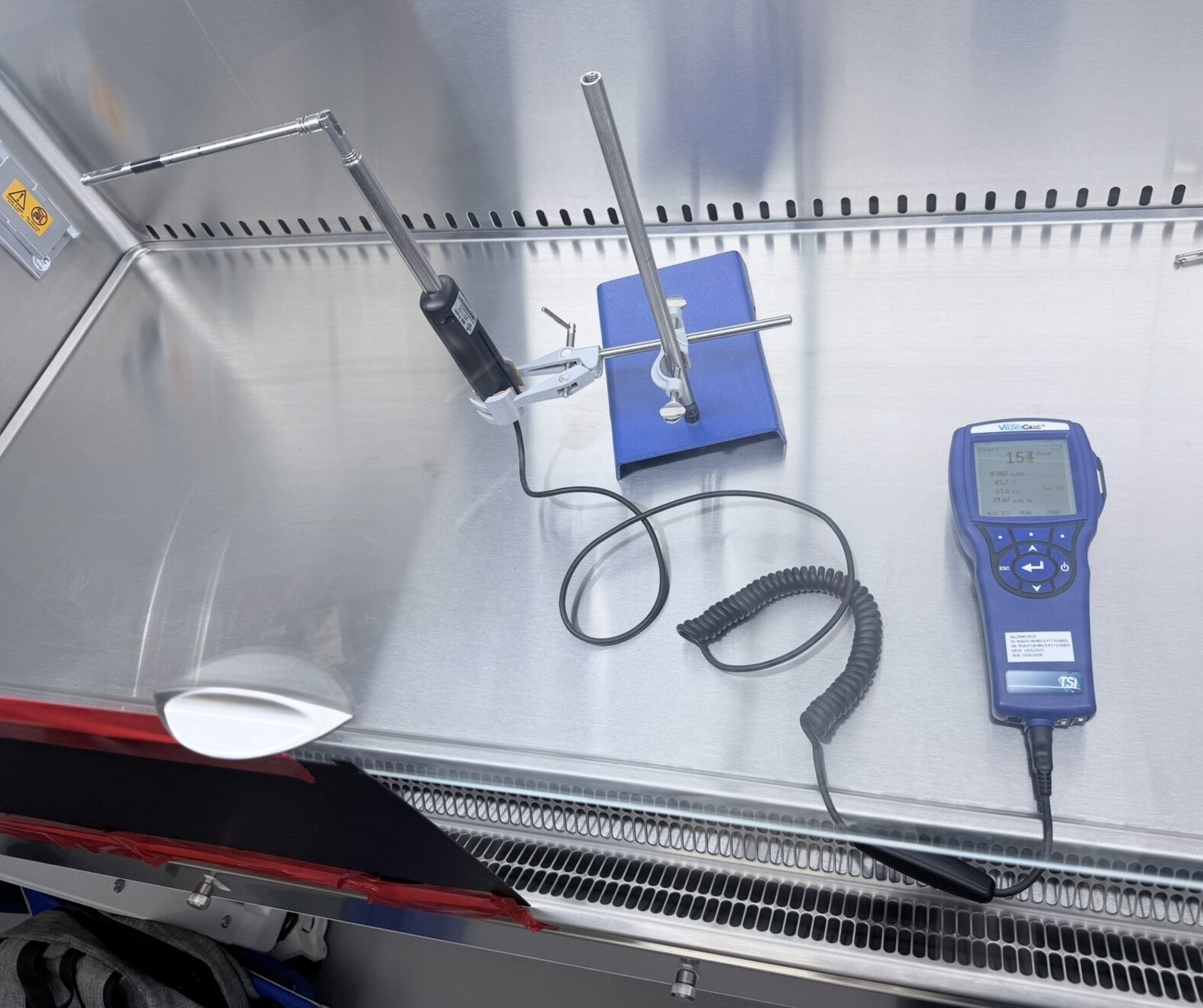
LabCertTech field certification in progress — NSF/ANSI 49 protocol, calibrated NIST-traceable equipment, inspection-ready documentation.
5. Who Requires NSF/ANSI 49 Compliance
NSF/ANSI 49 is referenced — directly or by implication — across a wide range of regulatory and accreditation frameworks:
| Standard / Body | How NSF/ANSI 49 Applies |
|---|---|
| USP <797> | Requires ISO 5 primary engineering controls (PECs) to be certified at least annually — BSCs are PECs and must be certified to NSF/ANSI 49 |
| USP <800> | Requires containment primary engineering controls (C-PECs) for hazardous drug compounding — Class II B2 BSCs must be NSF/ANSI 49 field certified |
| The Joint Commission (TJC) | EC and MM standards require documented equipment maintenance and performance verification — BSC field certification records are reviewed during surveys |
| State Boards of Pharmacy | Most states require annual BSC certification consistent with USP <797>/<800> — and inspectors specifically ask for current certification documentation |
| CDC / NIH BMBL | Recommends annual BSC certification for BSL-2 and above research facilities — NSF/ANSI 49 is the referenced standard |
| Institutional Biosafety Committees | Many IBCs require NSF/ANSI 49 field certification documentation as part of laboratory registration and renewal processes |
6. What NSF/ANSI 49 Requires of Certifiers
Annex F of NSF/ANSI 49 sets out what qualifies someone to perform a field certification. This is worth understanding because not every person who shows up with a photometer meets these requirements — and a certification performed by an unqualified individual may not be accepted by an inspector.
Per the standard, a qualified field certifier must:
- Have documented knowledge of NSF/ANSI 49, including cabinet classifications, performance requirements, and field test protocols
- Use calibrated, NIST-traceable instrumentation for all measurements — including anemometers, photometers, and manometers with current calibration certificates
- Perform the complete field certification protocol, not a partial inspection — face velocity, downflow, HEPA integrity, containment, product protection, smoke patterns, and electrical safety
- Produce a written certification report that includes raw test data, pass/fail determinations, instrument identification, calibration references, and certifier signature
- Clearly document any test failures and the recommended corrective actions
⚠ Ask to See the Calibration Certificates
A legitimate NSF/ANSI 49 field certifier should be able to produce calibration certificates for every instrument used during your certification — on request, without hesitation. If a certifier cannot provide these, the test data is not defensible and may not satisfy a regulatory inspector. This is a straightforward way to verify the quality of the certification you are receiving.
7. What an NSF/ANSI 49 Certification Report Should Include
Your certification report is your compliance documentation. If an inspector asks for proof of BSC certification, this is what they want to see. A complete, standard-compliant report should include:
- Facility and cabinet identification — facility name, address, cabinet make, model, and serial number
- Cabinet classification — Class II Type A2, B2, etc. as applicable
- Date of certification and the date the next certification is due
- Test results for each required test — including raw velocity grid data, HEPA scan results, containment test findings, and electrical safety checks
- Pass/fail determination for each test with the acceptance criteria referenced
- Test instruments used — make, model, serial number, and calibration certificate reference for each
- Certifier name and signature
- Corrective actions noted if any test resulted in a failure or advisory finding
A report that only shows a single velocity reading, a pass/fail checkbox, and a sticker is not a complete NSF/ANSI 49 field certification. It may satisfy a cursory check but will not hold up under a thorough regulatory inspection.
8. How LabCertTech Certifies to NSF/ANSI 49
At LabCertTech LLC, NSF/ANSI 49 field certification is the foundation of our BSC certification service. Here is exactly what that means for your facility:
- Full protocol compliance — we perform every test required under NSF/ANSI 49 Annex E, including inflow velocity, downflow velocity grid, HEPA filter integrity (PAO scan), KI Discus containment, product protection, smoke visualization, and electrical safety
- Calibrated, NIST-traceable equipment — all instruments arrive with current calibration certificates, available for your records
- Detailed certification reports — raw data, per-test pass/fail findings, instrument references, and certifier signature in a format designed for regulatory inspection readiness
- Same-day digital report delivery on a passed certification — so you are never waiting for your compliance documentation
- Class II B2 hard-ducted cabinet expertise — including coordination with building HVAC for exhaust system verification
- Remediation guidance on failures — we document exactly what failed, what it means, and what corrective action is required before a retest
- Regulatory context awareness — our reports are formatted with USP <797>/<800>, Joint Commission, and state board inspections in mind, not just the standard itself
NSF/ANSI 49 is the standard. What it requires is clear. What we do is make sure your cabinet meets it — and that your documentation proves it.
Schedule Your NSF/ANSI 49 BSC Certification
LabCertTech provides full NSF/ANSI 49 field certification for compounding pharmacies, hospital pharmacies, and research facilities across the Houston area. Contact us to schedule or ask about multi-equipment certification packages.
LabCertTech LLC | Houston, TX | labcerttech.net
About LabCertTech LLC
LabCertTech LLC is a Houston-based cleanroom and laboratory equipment certification company. We provide NSF/ANSI 49 BSC certification, chemical fume hood certification, HEPA filter testing, cleanroom particle counting, and full USP <797>/<800> compliance documentation for compounding pharmacies, hospital pharmacies, and research facilities. Learn more at labcerttech.net.