
Differential Pressure in Cleanrooms — What It Is, Why It Matters, and How It Is Verified
Published by LabCertTech LLC | Houston, Texas
Of all the environmental parameters that determine whether a compounding cleanroom is performing as required, differential pressure may be the one that operates most invisibly — and the one whose failure has the most immediate consequences. A HEPA filter that begins to load will degrade gradually over time. A differential pressure failure can reverse the direction of airflow between two rooms in seconds — potentially directing contamination directly into the most critical areas of your compounding environment.
Understanding what differential pressure is, what USP 797 and USP 800 require, and how it is verified during certification is essential knowledge for every compounding pharmacy director, designated person, and quality manager.
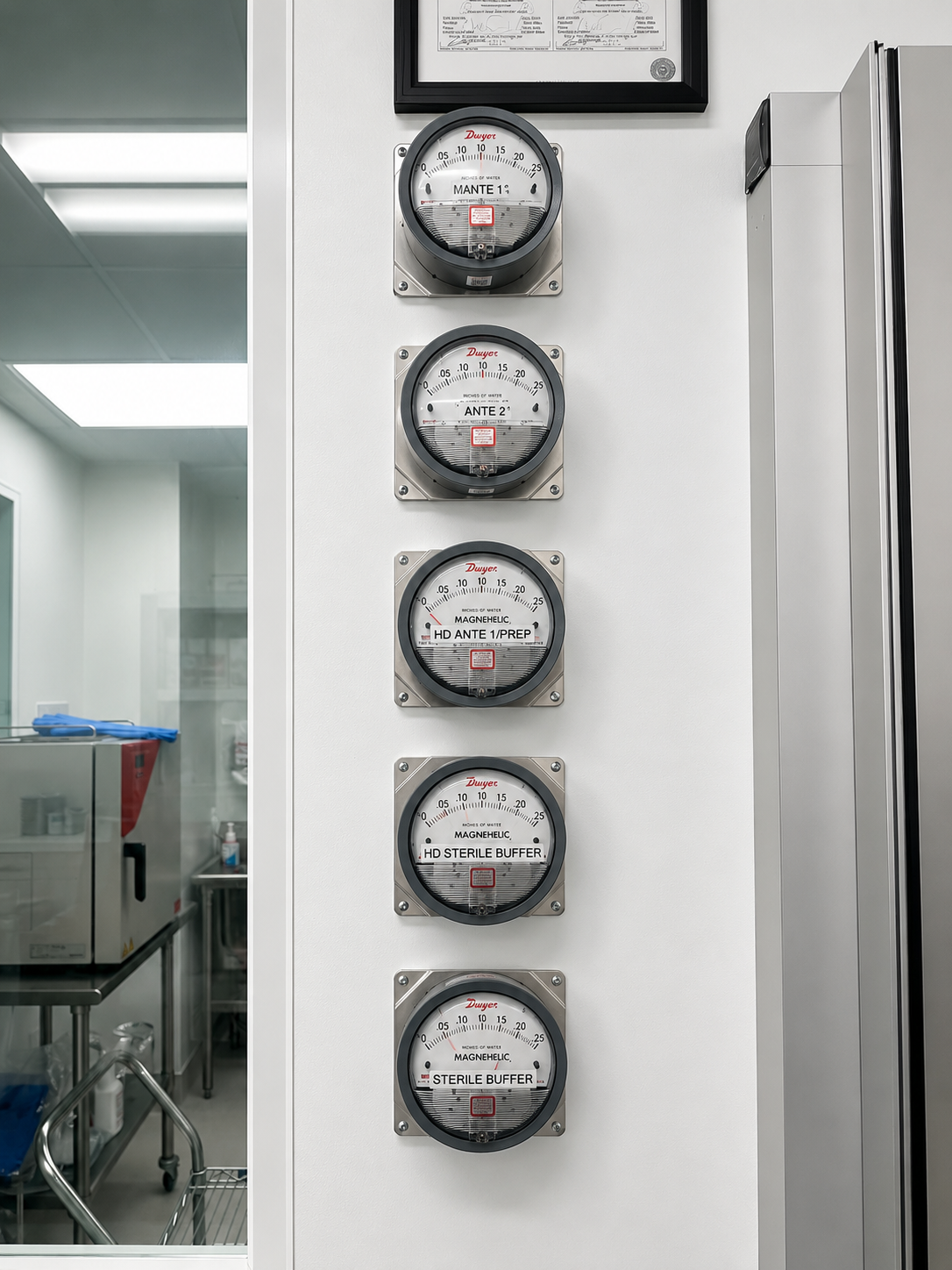
Differential pressure verification during cleanroom certification — Houston, Texas
What is Differential Pressure?
Differential pressure — also called room pressure or pressure differential — is the difference in air pressure between two adjacent spaces. In cleanroom environments, this difference is deliberately engineered and maintained to control the direction of airflow whenever air moves between rooms — through doorways, around door seals, through gaps in walls, or around penetrations.
The physical principle is straightforward: air always moves from areas of higher pressure to areas of lower pressure. By controlling which rooms are at higher or lower pressure relative to their neighbors, cleanroom designers control which direction contamination flows when any boundary between spaces is breached.
💡 Simple principle, critical consequence: When a door between two rooms opens, air flows from the higher pressure room into the lower pressure room — carrying particles and microorganisms with it. Differential pressure engineering ensures that this unavoidable airflow event moves contamination in the safe direction — away from critical compounding areas, not toward them.
Positive Pressure vs Negative Pressure — When Each is Required
Compounding facilities use both positive and negative pressure relationships depending on what they are designed to protect against. Understanding which configuration applies to which area of your facility is fundamental to USP 797 and USP 800 compliance:
| Pressure Type | How It Works | What It Protects | Required For |
|---|---|---|---|
| Positive Pressure | Room is at higher pressure than adjacent spaces — air flows outward when boundaries are breached | Protects sterile products inside from outside contamination entering | ISO 7 buffer rooms — sterile non-hazardous compounding (USP 797) |
| Negative Pressure | Room is at lower pressure than adjacent spaces — air flows inward when boundaries are breached | Protects personnel outside from hazardous materials escaping the room | Hazardous drug compounding rooms and storage areas (USP 800) |
USP 797 Differential Pressure Requirements
USP 797 establishes a pressure cascade for sterile compounding suites — a deliberate hierarchy of pressure from the cleanest areas outward to less clean areas. This cascade ensures that when any door in the compounding suite opens, the net airflow direction always favors the most critical areas:
- ISO 5 PEC — highest pressure point in the compounding suite, ensuring first air flows outward from the critical work zone
- ISO 7 buffer room — positive pressure relative to the ante-room and all adjacent spaces; minimum 0.02 inches of water column (w.c.) differential
- ISO 8 ante-room — positive pressure relative to the general pharmacy or corridor; minimum 0.02 inches of water column (w.c.) differential
This cascade means that a breach of any boundary in the compounding suite — a door opening, a gap around a penetration, a worn door seal — results in clean air flowing outward rather than contaminated air flowing inward.
📋 USP 797 Section 5 documentation requirement: Differential pressure verification is one of the required components of every cleanroom certification visit. The pressure differential between every pair of adjacent classified spaces must be measured and documented in the certification report — providing objective evidence that the required pressure relationships are being maintained.
USP 800 Differential Pressure Requirements
USP 800 requirements for hazardous drug compounding environments reverse the pressure relationship — the hazardous drug compounding area must be maintained at negative pressure relative to all adjacent spaces to prevent hazardous drug particles and vapors from escaping into surrounding areas:
- Sterile HD compounding ISO 7 buffer room (C-SEC) — negative pressure between 0.01 and 0.03 inches of water column relative to all adjacent areas
- Nonsterile HD compounding C-SEC — negative pressure between 0.01 and 0.03 inches of water column relative to all adjacent areas
- Containment Segregated Compounding Area (C-SCA) — negative pressure between 0.01 and 0.03 inches of water column relative to all adjacent areas
- HD storage rooms — negative pressure relative to surrounding areas
Facilities that compound both sterile non-hazardous preparations and hazardous drugs must simultaneously maintain positive pressure in the sterile compounding buffer room and negative pressure in the hazardous drug compounding room — a configuration that requires careful HVAC design and must be verified at every certification visit.
⚠️ The most challenging configuration: When a positive pressure sterile compounding buffer room and a negative pressure hazardous drug compounding room share a common ante-room or corridor, the pressure relationships on both sides of that shared space must be carefully managed and verified. A misconfiguration in either direction creates a compliance failure — and potentially a contamination or exposure event.
What Causes Differential Pressure Failures?
Differential pressure failures are one of the most commonly cited deficiencies during state board of pharmacy inspections. Common causes include:
- HVAC system imbalance or blower motor degradation reducing supply or exhaust air volumes
- Clogged supply or exhaust HEPA filters increasing resistance and reducing airflow
- Worn or damaged door seals allowing excessive air leakage between spaces
- Doors propped open or left ajar during compounding operations
- Construction or renovation in adjacent spaces affecting building pressure relationships
- Seasonal HVAC performance variations affecting supply and exhaust air balance
- Changes in building occupancy or equipment affecting pressure relationships in adjacent spaces
How Differential Pressure is Monitored and Documented
USP 797 and USP 800 both require that differential pressure be monitored on an ongoing basis — not just at certification visits. Facilities must have systems in place to monitor and document pressure readings throughout every operational day:
- Magnehelic gauges — analog pressure gauges mounted between adjacent spaces, read visually and recorded manually at defined intervals
- Electronic pressure monitors — digital devices that display, log, and can alarm on pressure excursions automatically
- Building automation systems — integrated facility management systems that provide continuous monitoring and automated alerting
Regardless of the monitoring method used, pressure readings must be documented at defined intervals and records retained for review during inspections. A facility with a magnehelic gauge but no pressure log has monitoring equipment — it does not have a monitoring program.
Differential Pressure Verification During Certification
During every cleanroom certification visit, LabCertTech verifies differential pressure as a required component of the airflow testing protocol under USP 797 Section 5. This involves:
- Measuring the actual pressure differential between all adjacent classified spaces using a calibrated manometer
- Verifying that measured differentials meet the minimum requirements of USP 797 and USP 800 for each specific area
- Documenting all pressure readings and pass/fail determinations in the certification report
- Identifying any spaces where pressure differentials are insufficient and providing specific findings to support corrective action
📊 What your certification report should show: A complete differential pressure section of your certification report should include measured pressure differentials between every pair of adjacent classified spaces — not just a single room-to-corridor reading. This gives inspectors a complete picture of the pressure cascade throughout your entire compounding suite.
How LabCertTech Can Help
LabCertTech LLC performs comprehensive differential pressure verification as part of every cleanroom certification for compounding pharmacies, hospitals, biotechnology laboratories, and research facilities across Houston, Texas and surrounding areas. Our NSF 49 certified technicians use calibrated manometers to measure and document pressure differentials between all adjacent spaces — providing the complete certification record your designated person needs to review and your state board inspector expects to find.
If your facility is experiencing differential pressure challenges — whether from HVAC degradation, seasonal variation, or construction — our certification findings provide the specific data your mechanical team needs to diagnose and correct the root cause.
Ready to Schedule Your Cleanroom Certification?
Contact LabCertTech today — Houston’s veteran owned, NSF 49 certified laboratory certification company.
Schedule a CertificationDifferential Pressure Cleanroom Certification USP 797 USP 800 ISO 14644 Houston TX LabCertTech