
Compliance Guide
Microbial Sampling in Sterile Compounding:
What USP <797> Actually Requires
Air and surface microbial sampling isn’t just a checkbox — it’s your early warning system. Here’s what the standard requires, what the numbers mean, and what happens when limits are exceeded.
By LabCertTech LLC | Houston, TX | Cleanroom & Equipment Certification Specialists
Environmental monitoring is one of the most frequently cited deficiencies during USP <797> inspections — not because pharmacies skip it entirely, but because they get the details wrong. Wrong timing. Wrong locations. Wrong media. Action levels exceeded with no documented corrective action. Sampling performed after cleaning instead of before.
The 2023 revision of USP <797> significantly tightened and clarified the microbial monitoring requirements for sterile compounding facilities. If your environmental monitoring program was built around the 2008 version of the chapter, it needs to be reviewed. This guide walks through exactly what the current standard requires for both viable air sampling and surface sampling — and what LabCertTech does to support your compliance program.
In This Guide
- Why Microbial Sampling Matters
- Viable Air Sampling — USP <797> Requirements
- Active Air Sampling Procedures (Box 5)
- Air Sampling Action Levels — Table 7
- Surface Sampling — USP <797> Requirements
- Surface Sampling Action Levels — Table 8
- What Happens When Action Levels Are Exceeded
- Most Common Monitoring Program Mistakes
- How LabCertTech Supports Your Monitoring Program
1. Why Microbial Sampling Matters
A cleanroom that passes its physical certification — ISO particle counts, HEPA filter integrity, airflow velocity — is not automatically a microbiologically clean environment. Viable microbial contamination is a separate, biological problem that physical testing does not detect. A certified ISO 5 environment can still harbor contamination introduced through personnel behavior, inadequate cleaning, improper garbing, or compromised materials handling.
Microbial sampling is the only way to detect this contamination before it reaches a patient. It answers questions that physical certification cannot:
- Are personnel introducing contamination during compounding operations?
- Is the cleaning and disinfection program actually working?
- Are work surfaces free of microbial growth between batches?
- Is the HEPA-filtered air in the ISO 5 PEC producing a truly microbiologically controlled environment?
USP <797> Section 6 addresses this directly — requiring a formal, documented monitoring program for viable airborne particles (Section 6.2) and viable surface particles (Section 6.3) across all classified areas.
2. Viable Air Sampling — USP <797> Requirements
USP <797> Section 6.2 requires that a monitoring program for viable airborne particles be developed, implemented, and documented for all classified areas. This is not optional and it is not satisfied by passive settle plates alone — the standard specifically requires volumetric active air sampling using an impaction air sampler.
Key requirements under Section 6.2.1:
- All classified areas must be sampled — this includes the ISO Class 5 PEC (primary engineering control), ISO Class 7 anteroom, and ISO Class 8 buffer room, as applicable
- Sampling must occur under dynamic operating conditions — meaning during or immediately following compounding activity, not in an idle or just-cleaned room
- Frequency for Category 1 and Category 2 CSPs: at least every 6 months
- Frequency for Category 3 CSPs: within 30 days prior to commencing Category 3 compounding, then at least monthly thereafter — regardless of how frequently Category 3 compounding actually occurs
- Sampling sites must be selected in all classified areas and documented in the facility’s SOPs
💡 Active vs. Passive Air Sampling
USP <797> requires active volumetric air sampling — meaning a calibrated impaction sampler that draws a known volume of air (at least 1 cubic meter / 1,000 liters per location) through or onto a sampling media device. Passive settle plates, while sometimes used as a supplement, do not satisfy the active sampling requirement. If your monitoring program relies only on settle plates, it is not compliant with the current chapter.
The growth media used must be a general microbiological growth media — such as Tryptic Soy Agar (TSA) — that supports the growth of both bacteria and fungi. Certificate of Analysis (COA) from the media manufacturer must be on file, confirming that the media meets growth promotion, pH, and sterilization requirements.
3. Active Air Sampling Procedures (USP <797> Box 5)
USP <797> Box 5 defines the step-by-step procedure for conducting active air sampling. The key steps are:
- Follow the manufacturer’s instructions for operation of the impaction air sampler, including correct placement of media devices
- Sample at least 1 cubic meter (1,000 liters) of air from each location sampled
- At the end of each sampling period, retrieve and cover the media device — handle to prevent condensate from dropping onto the agar and affecting colony counts
- Incubate at 30°–35°C for no less than 48 hours — examine for growth and record total colonies as cfu per cubic meter of air
- Then incubate at 20°–25°C for no less than 5 additional days — examine again and record results
- Alternatively, two media devices may be collected per location and incubated concurrently at the two temperature ranges to shorten the overall incubation period
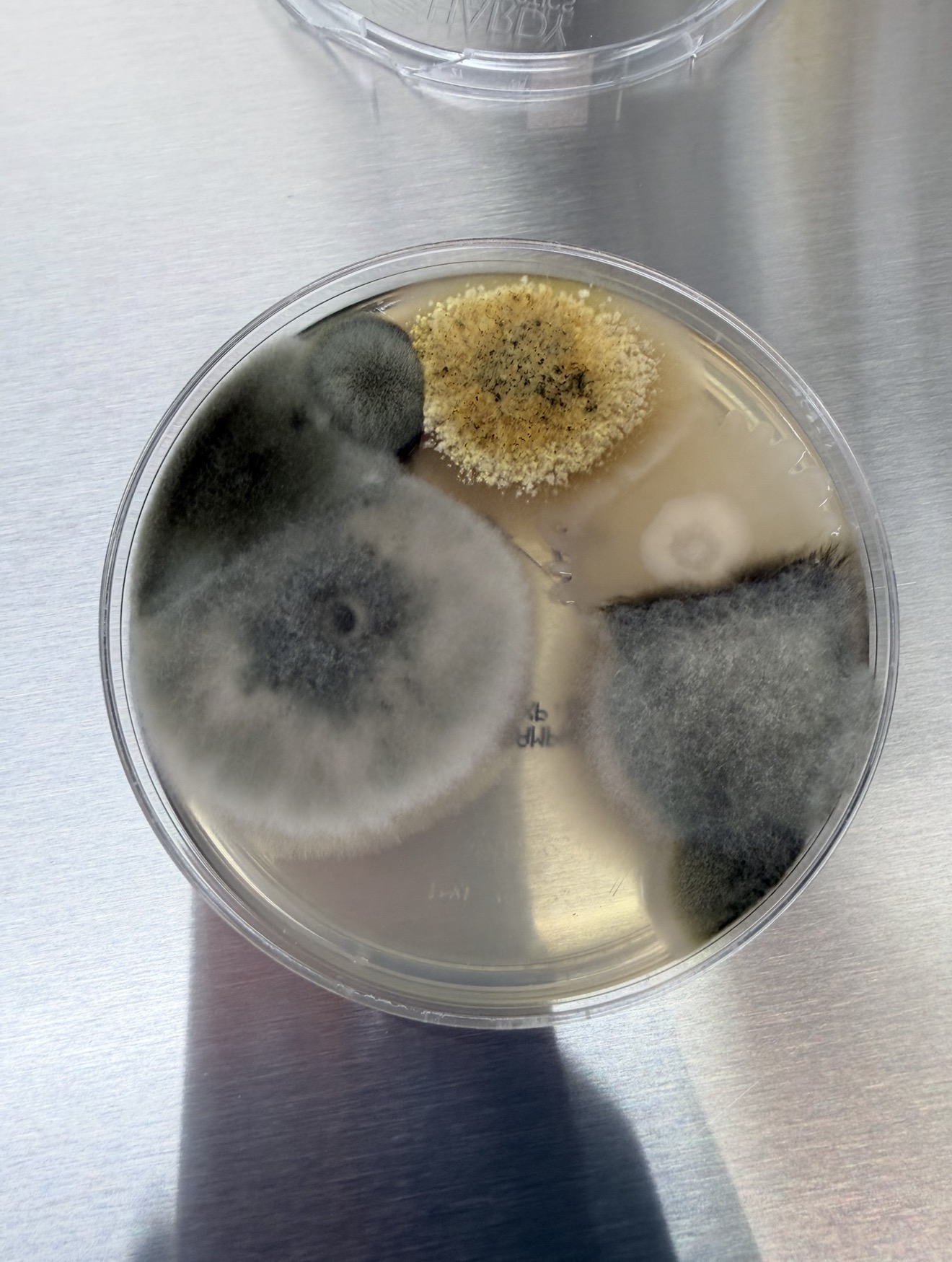
LabCertTech active air sampling in progress — volumetric impaction sampler, USP <797> Box 5 protocol, all classified areas sampled under dynamic operating conditions.
All results must be recorded on an environmental sampling form that captures sample type, sample location, and sample date. The incubator used must be placed outside the sterile compounding area, and incubator temperature must be monitored and documented throughout incubation.
⚠ Sampling in the PEC
When sampling inside the ISO Class 5 primary engineering control (BSC or laminar airflow workbench), USP <797> specifically cautions that care must be taken to avoid disturbing unidirectional airflow. Improper sampler placement within the PEC can create turbulence that both invalidates the air sample and temporarily compromises the ISO 5 environment — a detail that matters both for the accuracy of your monitoring data and the safety of any product being compounded nearby.
4. Air Sampling Action Levels — USP <797> Table 7
USP <797> Table 7 establishes the action levels for viable airborne particle air sampling by ISO classification. These are the thresholds that trigger investigation and corrective action:
| ISO Class | Classified Area | Action Level |
|---|---|---|
| ISO Class 5 | Primary Engineering Control (PEC) | >1 cfu / cubic meter |
| ISO Class 7 | Buffer Room | >10 cfu / cubic meter |
| ISO Class 8 | Anteroom | >100 cfu / cubic meter |
The ISO Class 5 limit of greater than 1 cfu per cubic meter is extremely tight — it means that a single colony recovered during air sampling inside the PEC triggers a required investigation. This reflects the direct relationship between the ISO 5 environment and patient safety: CSPs are prepared in this space, and any viable microbial contamination in the air represents a direct risk to product sterility.
If two sampling media devices are collected at a single location, action levels must be applied to each device separately — not averaged together.
5. Surface Sampling — USP <797> Requirements
Surface sampling under USP <797> Section 6.3 evaluates microbial contamination on work surfaces, equipment, and frequently touched areas within classified spaces. It serves a different but complementary purpose from air sampling — where air sampling assesses the microbiological quality of the environment, surface sampling assesses the effectiveness of cleaning and disinfection procedures and personnel work practices.
Key requirements under Section 6.3.1:
- All classified areas must be sampled — including each room, the interior of each ISO Class 5 PEC, and pass-through chambers connecting to classified areas
- Sample locations must include: equipment contained within the PEC, staging or work areas near the PEC, and frequently touched surfaces
- Timing: surface sampling should be performed at the end of a compounding activity or shift, before the area has been cleaned and disinfected — this is a common mistake, sampling after cleaning defeats the purpose
- Frequency for Category 1 and Category 2 CSPs: at least monthly for all classified areas and pass-through chambers
- Frequency for Category 3 CSPs: prior to assigning BUDs beyond Table 13 limits, and at least weekly thereafter; additionally, surface sampling must be conducted within the PEC at the end of each batch before cleaning
Surface sampling media devices must contain general microbial growth media (such as TSA) supplemented with neutralizing additives — specifically lecithin and polysorbate 80 — to neutralize any residual disinfecting agents on the sampled surface. Sampling with plain TSA in a recently disinfected area will suppress growth and produce falsely negative results. The neutralizing additives are not optional.
For irregular surfaces, crevices, and difficult-to-reach locations, sterile swabs wetted with sterile water or a sterile neutralizing buffer may be used in place of contact plates.
6. Surface Sampling Action Levels — USP <797> Table 8
USP <797> Table 8 establishes the action levels for surface sampling by ISO classification:
| ISO Class | Classified Area | Action Level |
|---|---|---|
| ISO Class 5 | PEC work surface | >3 cfu / media device |
| ISO Class 7 | Buffer Room surfaces | >5 cfu / media device |
| ISO Class 8 | Anteroom surfaces | >50 cfu / media device |
As with air sampling, action levels apply to each media device separately when two devices are collected at a single location. After surface sampling, the sampled area must be thoroughly cleaned and disinfected to remove the growth media residue left by the contact plate.
7. What Happens When Action Levels Are Exceeded
USP <797> is explicit: exceeding an action level is not just a data point to record — it requires a documented response. Here is what the standard requires when limits are exceeded for either air or surface sampling:
- Investigate the cause — the investigation must be documented and should be proportionate to the deviation. A single cfu at the ISO Class 5 action level requires a different response than recurring exceedances across multiple locations.
- Implement corrective action — examples cited in the standard include process or facility improvements, personnel retraining, enhanced cleaning and disinfecting, or HEPA filter repair or replacement
- Review data to confirm effectiveness — corrective actions must be verified as effective through follow-up sampling, not just assumed to have worked
- Resample failed areas — the corrective action plan must include resampling to confirm that the corrective action resolved the exceedance
- Attempt microorganism identification to the genus level — when action levels are exceeded, an attempt must be made to identify any recovered microorganism to the genus level, typically with the assistance of a microbiologist (per USP <1113>). This matters because different organisms point to different contamination sources — skin flora suggests personnel issues, environmental molds suggest facility or HVAC problems.
- Evaluate trends — the investigation should consider whether the exceedance is part of a pattern, not just an isolated event
⚠ Documentation Is the Compliance Event
During a USP <797> inspection, surveyors reviewing environmental monitoring data will look not just at the results but at the response to out-of-limit findings. An exceedance with no documented investigation, no corrective action plan, and no resampling confirmation is a more serious finding than the exceedance itself. The corrective action loop — investigate, correct, verify, document — must be complete and on file.
Surface sampling data collected in conjunction with media-fill testing must also be reviewed to assess aseptic manipulation competency — connecting the environmental monitoring program directly to personnel qualification.
8. Most Common Monitoring Program Mistakes
Based on common inspection findings and the requirements in USP <797>, these are the monitoring program gaps that create the most compliance exposure:
Mistake 01
Using Settle Plates Instead of Active Sampling
Passive settle plates do not satisfy USP <797>’s requirement for volumetric active air sampling. They may be used as a supplement but cannot replace an impaction sampler drawing a known air volume.
Mistake 02
Sampling After Cleaning
Surface sampling must be conducted before cleaning and disinfection — not after. Post-cleaning sampling suppresses growth and produces results that are not representative of actual contamination levels during operations.
Mistake 03
No Neutralizing Additives in Surface Media
Surface sampling media must contain lecithin and polysorbate 80 to neutralize residual disinfectants on the sampled surface. Plain TSA without neutralizers will produce false negatives in recently disinfected areas.
Mistake 04
Sampling Under Static Conditions
USP <797> requires sampling under dynamic operating conditions — during or immediately after compounding. Sampling an empty, idle room does not reflect the microbiological burden present during actual operations.
Mistake 05
No Documented Response to Exceedances
Recording an out-of-limit result without a documented investigation, corrective action plan, and resampling confirmation is itself a USP <797> violation. The response loop must be complete and on file.
Mistake 06
Missing COAs for Sampling Media
USP <797> requires that COAs from the media manufacturer be on file, verifying growth promotion, pH, and sterilization requirements. Using media without verified COAs leaves the validity of all sampling data in question.
9. How LabCertTech Supports Your Monitoring Program
LabCertTech LLC provides cleanroom and laboratory equipment certification services for compounding pharmacies, hospital pharmacies, and research facilities across the Houston area. While environmental microbial monitoring is ultimately a facility-managed ongoing program, our certification services directly support your compliance posture in several ways:
- HEPA filter integrity testing — a failed HEPA filter in your PEC or room HVAC is one of the most common root causes of recurring air sampling exceedances. Our PAO/DOP HEPA scan testing identifies filter failures before they become monitoring failures.
- BSC and PEC certification — proper airflow velocity, containment, and filter integrity in your ISO Class 5 PEC are prerequisite conditions for achieving compliant air sampling results. An uncertified or out-of-tolerance PEC makes compliant air sampling impossible.
- Cleanroom particle count testing — non-viable particle counts per ISO 14644-1 verify the physical cleanliness of your classified spaces as a complement to viable monitoring
- Inspection-ready documentation — our certification reports are formatted for USP <797>/<800> compliance audits and Joint Commission surveys, giving surveyors the equipment performance data they need alongside your monitoring records
A compliant environmental monitoring program depends on certified, functioning equipment. The two programs are not separate — they are the same compliance story told from two different angles.
Is Your Equipment Certified and Your Monitoring Program Current?
LabCertTech provides BSC certification, HEPA filter testing, and cleanroom particle count testing for compounding pharmacies and hospital pharmacies across the Houston area. Contact us to schedule or ask about compliance packages.
LabCertTech LLC | Houston, TX | labcerttech.net
About LabCertTech LLC
LabCertTech LLC is a Houston-based cleanroom and laboratory equipment certification company serving compounding pharmacies, hospital pharmacies, and research facilities. We provide NSF/ANSI 49 BSC certification, chemical fume hood certification, HEPA filter testing, cleanroom particle counting, and full USP <797>/<800> compliance documentation. Learn more at labcerttech.net.