
BSC Certification: Understanding Downflow, Product Protection, and Personnel Protection
Published by LabCertTech LLC | Houston, Texas
A Biological Safety Cabinet (BSC) is one of the most critical pieces of equipment in any sterile compounding pharmacy, hospital pharmacy, or research laboratory. But understanding exactly how a BSC protects both your product and your personnel — and how those protections are verified during certification — is essential for anyone responsible for BSC compliance.
In this post we’ll break down the science behind BSC airflow, explain what downflow and inflow velocity testing measure, and explain why both are critical components of every NSF/ANSI 49 field certification.
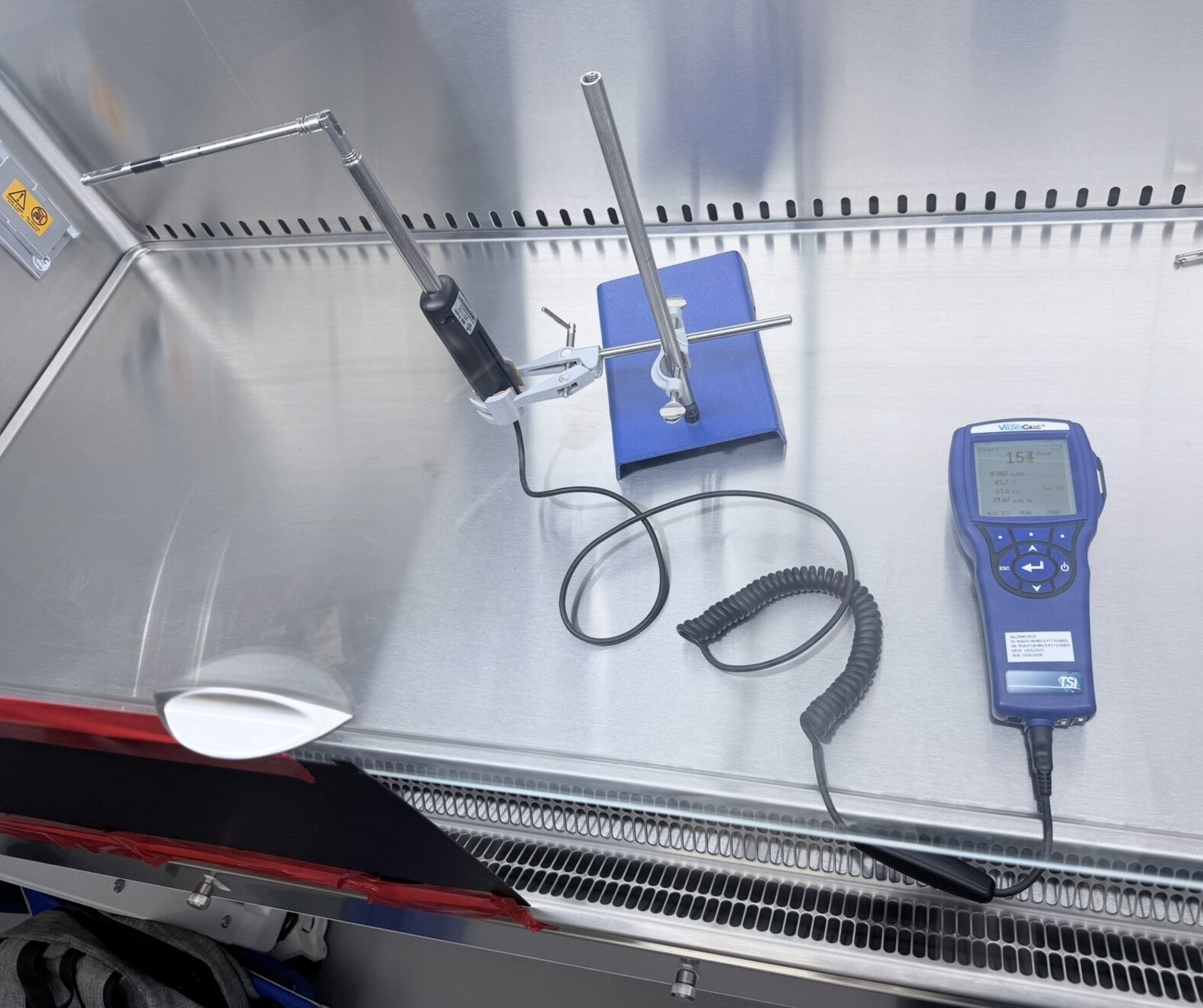
LabCertTech NSF 49 certified technician performing BSC downflow and inflow velocity testing in Houston, Texas
How Does a BSC Protect Product and Personnel?
A Class II Biological Safety Cabinet uses two distinct airflow mechanisms working together to simultaneously protect your sterile product and your compounding personnel:
- Downflow — HEPA filtered air flows downward through the work zone, creating a clean ISO 5 environment that protects your product from contamination
- Inflow — room air is drawn inward through the front opening of the cabinet, creating an air curtain that prevents hazardous biological agents or drug aerosols from escaping into the operator’s breathing zone
It is the precise balance between downflow and inflow velocities that makes a Class II BSC so effective. Too little downflow and your product is at risk. Too little inflow and your personnel are at risk. During NSF/ANSI 49 field certification both velocities are measured and verified to ensure your BSC is maintaining the correct balance.
Understanding Downflow Velocity
Downflow refers to the HEPA filtered air that flows vertically downward through the work zone of the BSC from the supply HEPA filter mounted in the top of the cabinet. This downflow of clean air serves two critical functions:
- Product protection — the downflow of HEPA filtered air sweeps particles and microorganisms away from critical work surfaces and open containers, preventing contamination of sterile preparations
- Split airflow barrier — the downflow air splits at the work surface, with a portion being recirculated back through the supply HEPA filter and a portion being exhausted through the exhaust HEPA filter, creating the airflow pattern that makes the BSC work
🔬 NSF/ANSI 49 downflow requirement: For Class II Type A2 BSCs, NSF/ANSI 49 requires a minimum average downflow velocity of 75 feet per minute (FPM) across the work zone. Individual measurements must not deviate more than plus or minus 20% from the average downflow velocity.
Understanding Inflow Velocity
Inflow refers to the room air that is drawn into the BSC through the front opening — the space between the bottom of the sash and the work surface. This inward flow of room air is what provides personnel protection by:
- Creating an air curtain — the inward flow of room air at the front opening acts as an invisible barrier, preventing hazardous biological agents, drug aerosols, or other contaminants from escaping the cabinet into the operator’s breathing zone
- Negative pressure effect — the inflow creates a slight negative pressure effect at the front opening relative to the room, ensuring that any accidental release of hazardous material inside the cabinet is contained
🔬 NSF/ANSI 49 inflow requirement: For Class II Type A2 BSCs, NSF/ANSI 49 requires a minimum average inflow velocity of 75 feet per minute (FPM) at the front opening with the sash at the normal operating height. The inflow velocity must be sufficient to contain aerosols generated inside the cabinet.
How Downflow and Inflow Are Measured During Certification
During NSF/ANSI 49 field certification, an NSF 49 certified technician measures both downflow and inflow velocities using a calibrated thermal anemometer or electronic velocity meter. Here’s how each measurement is performed:
| Test | Method | Measurement Points | Pass Criteria |
|---|---|---|---|
| Downflow velocity profile | Calibrated anemometer positioned at defined grid points across work zone | Minimum of 9 points across work surface per NSF/ANSI 49 | Average meets minimum; no individual point deviates more than 20% |
| Inflow velocity | Calibrated anemometer positioned at front opening at defined measurement points | Multiple points across the full width of the front opening | Average inflow meets minimum required velocity |
All measured values are documented in the certification report, along with calculated averages and pass/fail determinations for each parameter. This data provides objective, quantifiable evidence that your BSC is performing as required.
What Happens When Downflow or Inflow Fails?
If downflow or inflow velocity measurements fall outside acceptable limits during certification, the BSC must be taken out of service immediately until the cause of failure is identified and corrected. Common causes of downflow and inflow failures include:
- Low downflow — clogged or loaded supply HEPA filter reducing airflow; blower motor degradation; incorrect blower speed setting
- Low inflow — clogged exhaust HEPA filter; blocked exhaust ductwork; incorrect exhaust fan speed
- Uneven downflow profile — HEPA filter leak or damage causing uneven air distribution; obstruction inside the cabinet affecting airflow pattern
- Sash position issues — cabinet operated with sash above normal working height, reducing inflow velocity at the front opening
After corrective action is taken — which may include HEPA filter replacement, blower adjustment, or ductwork repair — the BSC must be retested and pass all required NSF/ANSI 49 tests before returning to service.
Why Downflow and Inflow Testing Matters for Your Facility
The consequences of operating a BSC with inadequate downflow or inflow velocities are serious:
- Inadequate downflow — compromises product sterility, potentially leading to contaminated preparations and patient harm
- Inadequate inflow — exposes compounding personnel to hazardous biological agents or drug aerosols, creating occupational health and safety risks
- Both — place your facility out of compliance with USP 797, USP 800, and NSF/ANSI 49, risking citations, operational shutdowns, and accreditation loss
💊 Patient safety connection: A BSC with inadequate downflow velocity cannot reliably maintain ISO 5 conditions at the critical work zone. Sterile preparations compounded in a failing BSC are at elevated risk of microbial contamination — a direct patient safety concern that goes far beyond regulatory compliance.
The Importance of NSF 49 Certified Technicians for BSC Certification
Accurate downflow and inflow velocity measurement requires properly calibrated equipment, correct measurement technique, and thorough understanding of NSF/ANSI 49 requirements. This is why choosing an NSF 49 certified technician for your BSC certification matters — certified technicians have formally demonstrated their knowledge of these requirements and their proficiency with the test equipment used to verify BSC performance.
At LabCertTech LLC, our BSC certifications are performed by NSF 49 certified technicians using calibrated test equipment — ensuring your certification results are accurate, reliable, and defensible during inspections.
How LabCertTech Can Help
LabCertTech LLC provides comprehensive NSF/ANSI 49 field certification services for biological safety cabinets in compounding pharmacies, hospitals, biotechnology laboratories, and research facilities across Houston, Texas and surrounding areas. Our NSF 49 certified technicians perform complete downflow velocity profile testing, inflow velocity testing, HEPA filter integrity testing, and all other required NSF/ANSI 49 field certification tests.
We provide detailed certification reports documenting all measured velocities, pass/fail status, and any corrective actions required — ready for state board of pharmacy inspections and accreditation reviews.
Ready to Schedule Your BSC Certification?
Contact LabCertTech today — Houston’s veteran owned, NSF 49 certified laboratory certification company.
Schedule a CertificationBSC Certification Downflow Velocity Inflow Velocity NSF/ANSI 49 Biological Safety Cabinet Houston TX LabCertTech